

The home battery that keeps an eye on electricity prices
It charges cheaply and, in expensive hours, runs your home and sells the solar surplus. It plans around prices and the weather. You just check the result.
Smart Control Device with software Suggested retail price
€400incl. VAT
Find a distributor- Works without the internet too** Up to 48 hours without an internet connection.
- No subscription — you pay once
- Tariffs in Ireland and across the EU
Electricity prices change every hour. Smart Control turns that into savings.
On a sunny midday the market price of energy can drop below zero, while in the evening the same kilowatt-hour costs several times more. A home battery can turn that difference into money if someone decides every day when to charge it and when to discharge it. That someone is Smart Control.
Step 1: Checks prices and weather
It fetches energy prices for every hour of the next day (from PSE, the Polish grid operator, or from Pstryk) and a production forecast for your panels, calculated separately for each string from weather models.
Step 2: Plans every hour
From its measurements it learns how much electricity your home uses on weekdays and at weekends. Based on that, it decides when to charge the battery, when to use it and when to sell the surplus. The plan also counts battery wear, so the battery only works when it pays off.
Step 3: Controls the inverter
It sends commands to the hybrid inverter and checks that they were carried out. If the internet goes down, it keeps working on the data it has stored.
Scene 1 of 4: The evening before
Smart Control fetches tomorrow's electricity prices for every hour and the sun forecast for your panels. From them, it builds a plan for the whole day.
See how much your battery could earn
Choose a day, set up your installation and tariff, and play the day. We compare three homes on the same tariff: with solar panels only, with a battery without control, and with a battery run by Smart Control.
Electricity prices today, live
Fetching prices from PSE…
Source: PSE, the Polish transmission system operator, Market Energy Price (RCE). Wholesale prices in Polish time, without distribution charges or taxes.
Prices from the Polish market, converted from złoty at the European Central Bank's rate of 16 November 2026 (1 € = 4.403 PLN).
At midday there is so much sun that the price drops below zero. In the evening it jumps.
Chart of the day: the electricity price in every hour, the battery's state of charge and what Smart Control does in each hour. The same data is in the “Hour-by-hour data” table below the simulator.
End of the day. Move the slider to see any hour.
- Sun charges the battery
- Battery charges from the grid
- Home runs on the battery
- Battery powers the home and sells
- Solar surplus to the grid
- Zero or negative price: no surplus to the grid
- Home on the grid, battery waits
- Battery state of charge
- Electricity price in the hour, negative hatched
This day's balance
The same installation and the same tariff: Dynamic, hourly RCE. Plus means earnings, minus means a bill.
This installation's deposit is left with a surplus over the year: the deposit pays for energy from the grid, so you pay only for distribution, and a sale adds 30% of its value. That is how the day's balance and the year are counted.
- Solar panels only+€0.15no battery
- Battery without control+€0.28inverter in self-consumption mode
- Battery with Smart Control+€0.71plan based on prices and forecast
Smart Control adds on this day
+€0.43
compared with the same battery without control
- Per year compared with a battery without control
- approx. €70
- Per year compared with solar panels only
- approx. €290
The year is the average of three sample days. It is a projection, not a promise of results. Where do these numbers come from?
Prices from the Polish market, converted from złoty at the European Central Bank's rate of 16 November 2026 (1 € = 4.403 PLN).
We will calculate this for your installation
Send us these settings. We will check whether your inverter works with Smart Control and calculate the result on your tariff.
Send these settingsWe will enter the panel power, battery capacity, consumption and tariff in the form for you.
Your installation
Your tariff
Dynamic, hourly RCE
Choose the tariff from your contract and enter the rates from your bill. The simulation and the tariff comparison use them.
The seller's margin, excise duty, distribution and per-kWh charges, gross. On top of that, the exchange price with VAT. By default PGE's 2026 rates.
The best tariff for Smart Control
The G12, hourly RCE tariff gives about €110 more a year than yours.
Your installation over a year on every tariff, with the battery run by Smart Control.
Updating the comparison…
- G12, hourly RCEcheapestearnings about €180
Smart Control adds about €160 over a battery without control
- G12D, hourly RCEcheapestearnings about €180
Smart Control adds about €160 over a battery without control
- G12w, hourly RCEearnings about €170
Smart Control adds about €140 over a battery without control
- G11, hourly RCEearnings about €80
Smart Control adds about €70 over a battery without control
- Dynamic, hourly RCEYour tariffearnings about €80
Smart Control adds about €70 over a battery without control
A year is the average of the three sample days, and for G12w the weekends too. We count the per-kWh charges. Fixed fees (trade fee, fixed distribution, capacity fee) depend on the tariff and the seller, so check them in the offer.
When the deposit has a surplus over the year, the bill no longer depends on the energy price: distribution and sales count. That is why tariffs with the same distribution (G12 and G12D, G11 and dynamic) come out the same.
- Smart Control adds on this day
- +€0.43
- Per year compared with a battery without control
- approx. €70
Where do these numbers come from?
It is a projection from a model, not a promise of results. The Smart Control plan is the theoretical maximum with the “Profit” priority: the model knows the whole day's prices, sunshine and consumption in advance and for every hour chooses charging, discharging or waiting so that the day's bill is as low as possible. In practice, the device earns less.
- Hourly prices: three sample days in the style of PSE RCE quotes; the “Today” day uses real RCE prices from PSE.
- Buying from the grid follows your tariff: on the dynamic tariff and G12D, the hourly price with 23% VAT plus a rate added to every kWh; on G11, G12 and G12w, the price of the zone. Rates are gross, with distribution and per-kWh charges; the defaults come from PGE's 2026 price lists.
- G12, G12w and G12D zones as at PGE Dystrybucja: the night from 22:00 to 6:00 is cheaper, and so are two afternoon hours, 15:00–17:00 in summer and 13:00–15:00 in winter; on G12w the whole weekend too.
- Selling under net-billing: the energy goes into the deposit at the RCE price × 1.23, and at a zero or negative price it earns nothing; with RCEm the whole day has one price, the average of its prices. The deposit pays for energy only, not for distribution, and what is left of it after a year comes back as 30% (RCE) or 20% (RCEm). Under net-metering, a kWh sent out comes back as 0.8 kWh, and the discount over a year never exceeds what the home took from the grid.
- We count the year as the bill does, by these rules. When the deposit or the discount has a surplus, Smart Control plans with what really changes the bill, and the day's balance shows how much the day changes the yearly bill.
- Battery: 95% efficiency each way, discharge down to 10%, charging power of half the capacity per hour. The plan accounts for battery wear (€0.02 per kWh).
- Smart Control buys energy from the grid only for the home: over a day it never sells more than the panels produced.
- Smart Control sells from the battery only with hourly settlement. With RCEm and under net-metering the battery works for the home: the gain comes from self-consumption and the cheaper zones.
- Sunshine and home consumption are typical profiles for the season, not measurements from your installation.
Hour-by-hour data
| Hour | Market price | Buying | Selling | What happens | Battery |
|---|---|---|---|---|---|
| 00:00 | 0.10 €/kWh | 0.26 €/kWh | 0.12 €/kWh | The home runs on energy from the battery | 19% |
| 01:00 | 0.09 €/kWh | 0.26 €/kWh | 0.11 €/kWh | The home runs on energy from the battery | 16% |
| 02:00 | 0.09 €/kWh | 0.25 €/kWh | 0.11 €/kWh | The home runs on energy from the battery | 15% |
| 03:00 | 0.09 €/kWh | 0.25 €/kWh | 0.11 €/kWh | The home runs on energy from the battery | 13% |
| 04:00 | 0.09 €/kWh | 0.25 €/kWh | 0.11 €/kWh | The home runs on energy from the battery | 10% |
| 05:00 | 0.10 €/kWh | 0.26 €/kWh | 0.12 €/kWh | The solar surplus goes to the grid | 10% |
| 06:00 | 0.09 €/kWh | 0.26 €/kWh | 0.11 €/kWh | The solar surplus goes to the grid | 10% |
| 07:00 | 0.08 €/kWh | 0.24 €/kWh | 0.10 €/kWh | The solar surplus goes to the grid | 10% |
| 08:00 | 0.05 €/kWh | 0.21 €/kWh | 0.07 €/kWh | The solar surplus goes to the grid | 10% |
| 09:00 | 0.02 €/kWh | 0.17 €/kWh | 0.03 €/kWh | The solar surplus goes to the grid | 10% |
| 10:00 | 0.00 €/kWh | 0.15 €/kWh | 0.01 €/kWh | The solar surplus goes to the grid | 10% |
| 11:00 | −0.01 €/kWh | 0.13 €/kWh | 0.00 €/kWh | The sun is charging the battery | 51% |
| 12:00 | −0.02 €/kWh | 0.12 €/kWh | 0.00 €/kWh | The sun is charging the battery | 91% |
| 13:00 | −0.01 €/kWh | 0.13 €/kWh | 0.00 €/kWh | The sun is charging the battery | 100% |
| 14:00 | −0.00 €/kWh | 0.14 €/kWh | 0.00 €/kWh | Battery full, price zero or negative: the inverter keeps the surplus off the grid | 100% |
| 15:00 | 0.02 €/kWh | 0.17 €/kWh | 0.02 €/kWh | The solar surplus goes to the grid | 100% |
| 16:00 | 0.05 €/kWh | 0.21 €/kWh | 0.07 €/kWh | The solar surplus goes to the grid | 100% |
| 17:00 | 0.09 €/kWh | 0.26 €/kWh | 0.11 €/kWh | The solar surplus goes to the grid | 100% |
| 18:00 | 0.13 €/kWh | 0.30 €/kWh | 0.16 €/kWh | The solar surplus goes to the grid | 100% |
| 19:00 | 0.16 €/kWh | 0.34 €/kWh | 0.20 €/kWh | The solar surplus goes to the grid | 100% |
| 20:00 | 0.19 €/kWh | 0.38 €/kWh | 0.23 €/kWh | The battery powers the home and sells the surplus | 48% |
| 21:00 | 0.17 €/kWh | 0.36 €/kWh | 0.21 €/kWh | The battery powers the home and sells the surplus | 33% |
| 22:00 | 0.13 €/kWh | 0.30 €/kWh | 0.16 €/kWh | The home runs on energy from the battery | 27% |
| 23:00 | 0.11 €/kWh | 0.27 €/kWh | 0.13 €/kWh | The home runs on energy from the battery | 22% |
What Smart Control costs
You buy a ready-made device with its software from one of our distributors. An installer connects it to the inverter and commissions it in a single wizard.
Device with software
- Suggested retail price
- €400incl. VAT
- The final price is set by the distributor.
The price covers the device together with the installed Smart Control software. You don't need a computer or server of your own.
You pay once. Control by energy prices and the weather forecast works without a subscription.
Find a distributorIncluded in the price
- A device ready to connect to a Deye three-phase hybrid inverter
- A plan for every hour based on energy prices, your tariff and the weather forecast
- A panel in your browser: basic and advanced view
- E-mail alerts about faults, for you and your installerThe e-mails and notifications are in Polish.
- Security updates for at least 5 years from installation
- At extra cost
- The Integrator add-on, the GSM module.
- Installation
- Connecting it to the inverter and commissioning are done by an installer. The distributor quotes the price with installation.
Are you an installer? Partner prices and terms of cooperation
A company, or a project with special requirements? Individual quote
Nothing to operate day to day
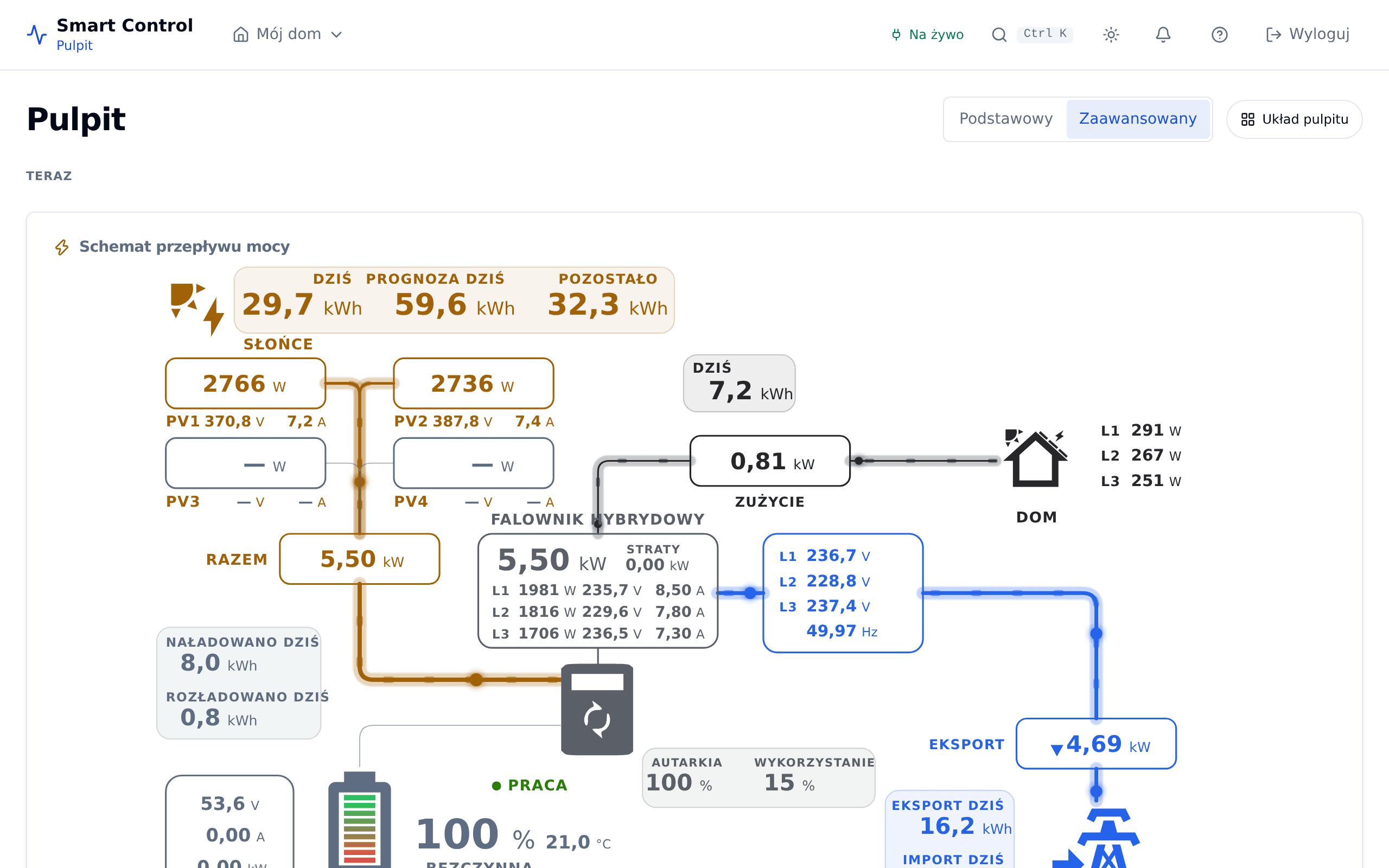
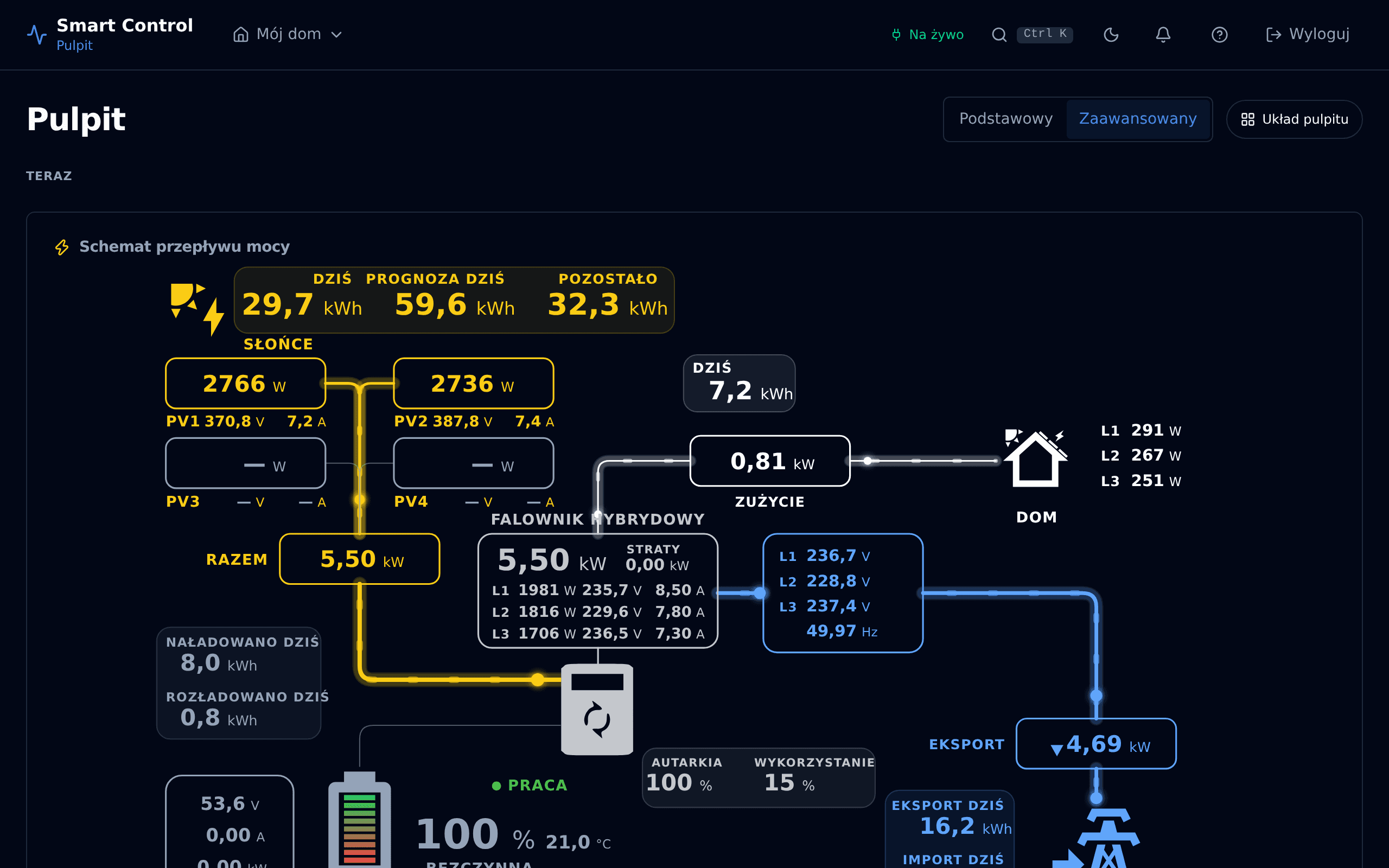
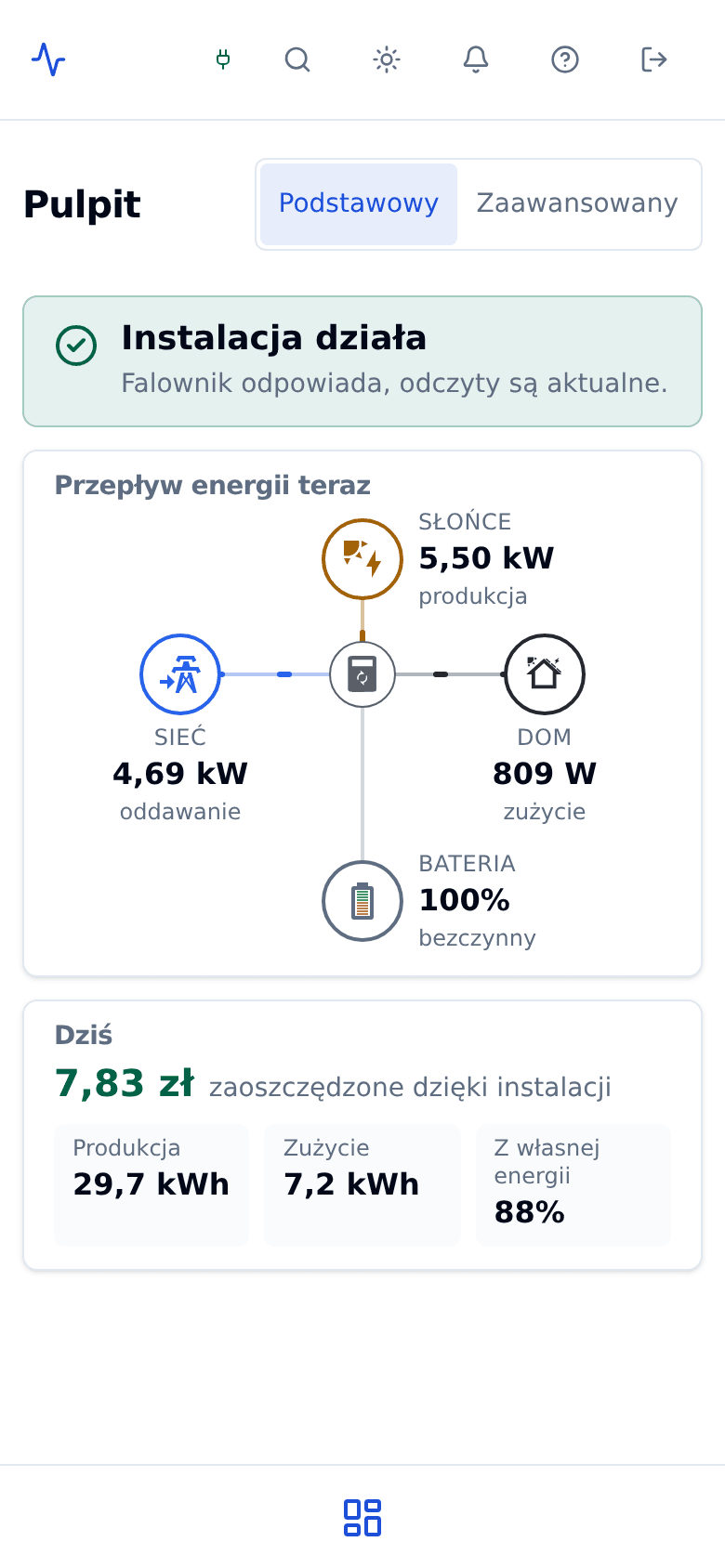
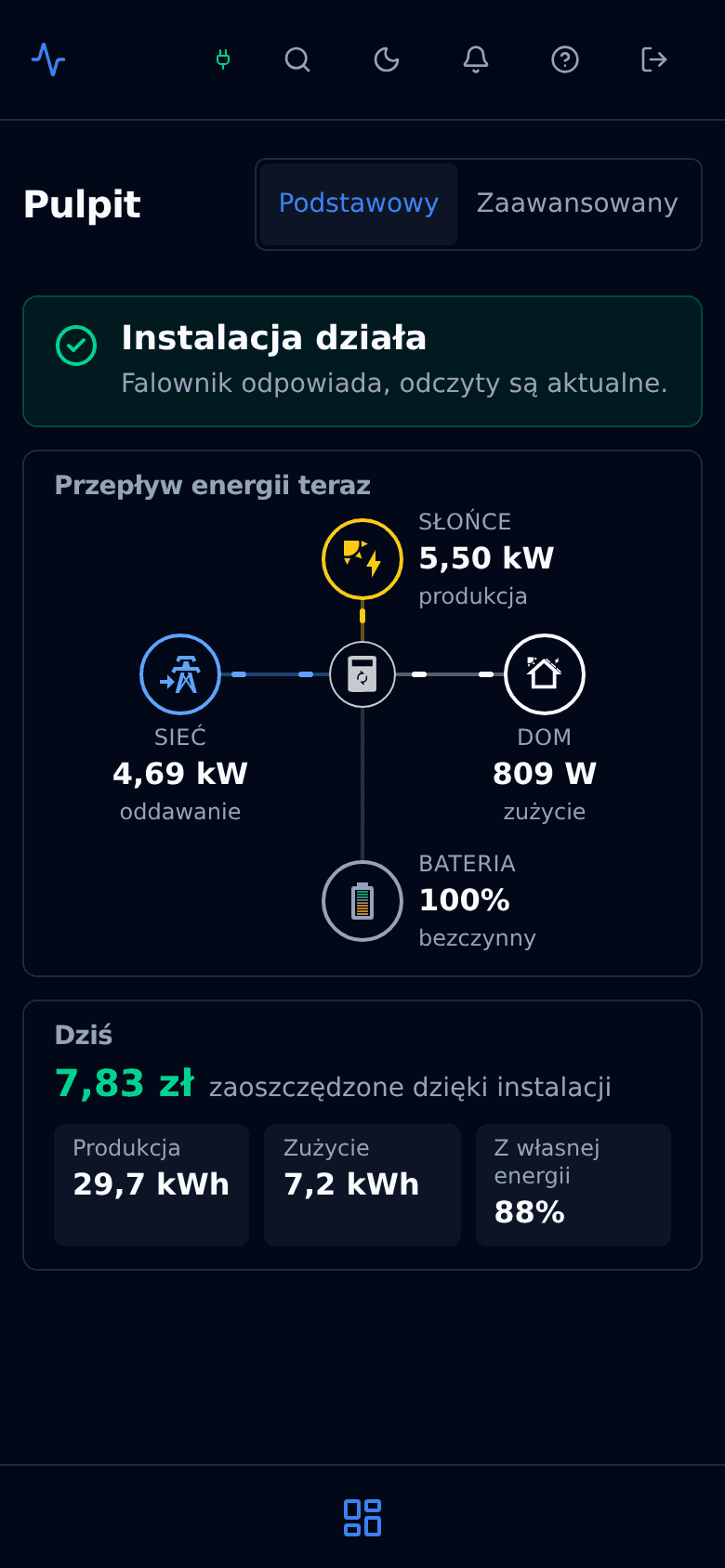
Smart Control works on its own. When you want to see how it is doing, you open the panel in your browser. First you see only what matters. The details are one switch away.
Basic view
Where your home is getting electricity right now: from the sun, the battery or the grid. And how much you have saved today.
Advanced view when you want more
History, prices for every hour and the system's decisions, hour by hour.
You choose the goal
The most of your own energy or the highest profit. Smart Control sets up the rest by itself.
Savings report
To print or send, with your installer's logo.
In the browser, in English
On a computer, tablet and phone, with no app to install. The panel opens in your browser's language: English, Polish or German.
The questions we hear most often
Which inverter do I need?
Smart Control works with Deye three-phase hybrid inverters, with a low- or high-voltage battery. The battery can be any model the inverter supports. Have a different inverter? Write to us and we will check.
What does the price of Smart Control include?
The suggested retail price is €400 including VAT for the device with its software installed. You pay once, and control by energy prices works without a subscription. You buy Smart Control from our distributors; the distributor sets the final price, installation included. Projects tailored to specific requirements, for example for companies, are quoted individually.
Do I need a dynamic tariff?
No, but that is where you earn the most. With hourly prices (a Polish dynamic tariff with PSE RCE prices, Pstryk, net-billing settled every hour) it matters at what time you buy and sell energy. On G11–G13 tariffs Smart Control also lowers the bill, because it increases self-consumption and avoids the expensive zones, but there the hour of a sale does not change the income.
What happens when the internet goes down?
Smart Control keeps working: planning, control and logging run at home. It then takes the forecast from the most recently downloaded data, and when that runs out, from statistics of your own panels' production. Where there is no fixed internet, you can add an optional GSM module: it provides a connection over the mobile network.
Does Smart Control buy electricity from the grid to resell it?
No. It buys electricity from the grid only for the home, and over a day it sells at most as much energy as the panels produced. That is what the regulations require, and that is how the system works.
Can I switch the control off?
Yes. The installer switches control on during commissioning. With one switch you hand it back to the inverter, and you can also use monitoring only.
Can I check the installation when I'm away from home?
Today the panel works on your home network, in the browser on a computer, tablet and phone. Access over the internet is in preparation.
Who installs Smart Control?
A solar installer. The device arrives ready, and the installer commissions it on site with the wizard. If you are looking for an installer, write to us.
Do updates cost extra?
Security updates are free for at least 5 years from installation. They install themselves at night, and Smart Control makes a backup before each one.
Let's talk about your installation
Tell us what installation you have or are planning. We will check whether Smart Control will work with it and how much it could deliver. Are you an installer? Mark it in the form.
You will hear back from the EMS HOUSE team in Toruń.
- kontakt@ems.house
- +48 669 800 222on working days 8:00–16:00
Prefer to talk? Choose a time
EMS HOUSE Sp. z o.o.ul. Świętej Faustyny 16B/6787-100 Toruń